Preparing People and Teams for Agentic AI: Skills, Topologies and the Talent Pipeline
As a cloud architect, most of my work sits across IT and business teams. That vantage point gives me a clear view of how work moves between groups, how operating models form around it, and where governance holds and where it doesn't.
Now that agentic AI is taking on parts of that work, I’ve been focusing on its practical impact: how teams function, how people develop, and what leaders should start doing now to benefit from the shift rather than react to it.
No one has the full answer yet. This is my current thinking on people and teams, written mainly with regulated firms in mind where accountability and governance leave less room to improvise.
Plan Capabilities, Not Job Titles
You can think of every role in the company as a bundle of skills. As agents become more capable, they start taking on some of those skills, handling individual tasks end to end. In one report, Boston Consulting Group suggests 50 to 55% of US jobs will be reshaped this way within a few years.
The sensible response is to plan around skills, which are more stable than job titles. In a skills‑based model, teams are defined by the capabilities they must hold and the outcomes they own. The job catalogue becomes an inventory of what people can do.
To make that shift work in practice, organisations need a few core elements:
- A shared skills language. One taxonomy, so HR, learning and the business use the same words for the same capabilities.
- A live skills inventory. Real-time data on who can actually do what, based on current work.
- Skills-driven demand forecasting. Translate strategy into the skills the organisation will need, including how quickly some will age.
- A clear view of gaps. The shortages, the surpluses, and the single points of failure where losing one person creates risk.
- Targeted talent moves. Close gaps by reskilling, redeploying and hiring or handing the task to an agent.
One approach worth considering is the work the Financial Services Skills Commission has done on a skills‑based organisation framework, where skills become the core unit of workforce planning. It was originally designed to address the sector’s broader skills gap, but the underlying idea applies just as well in an agentic world.
Build on Team Topologies
One of the more popular approaches to building AI-ready teams, and one a lot of articles mention, is to go flatter: small, autonomous pods with less hierarchy. Deloitte found 53% of firms have explored such structures, though only 16% acted. I read that gap as caution, not firms falling behind. In a regulated firm, flat pods make it harder to show clear personal accountability under the FCA's Senior Managers and Certification Regime (SM&CR).
A better starting point might be Team Topologies, a well-known model for organising work around durable capabilities and cognitive load. The idea is deliberately small: four standard team types (stream-aligned, platform, enabling and complicated-subsystem), linked by three interaction modes: collaboration, as-a-service and facilitating.
Applied to an agentic operating model, it looks like the diagram below. In the centre you can see the agent fleet, which becomes a shared platform: built and controlled in one place rather than reinvented in every team.
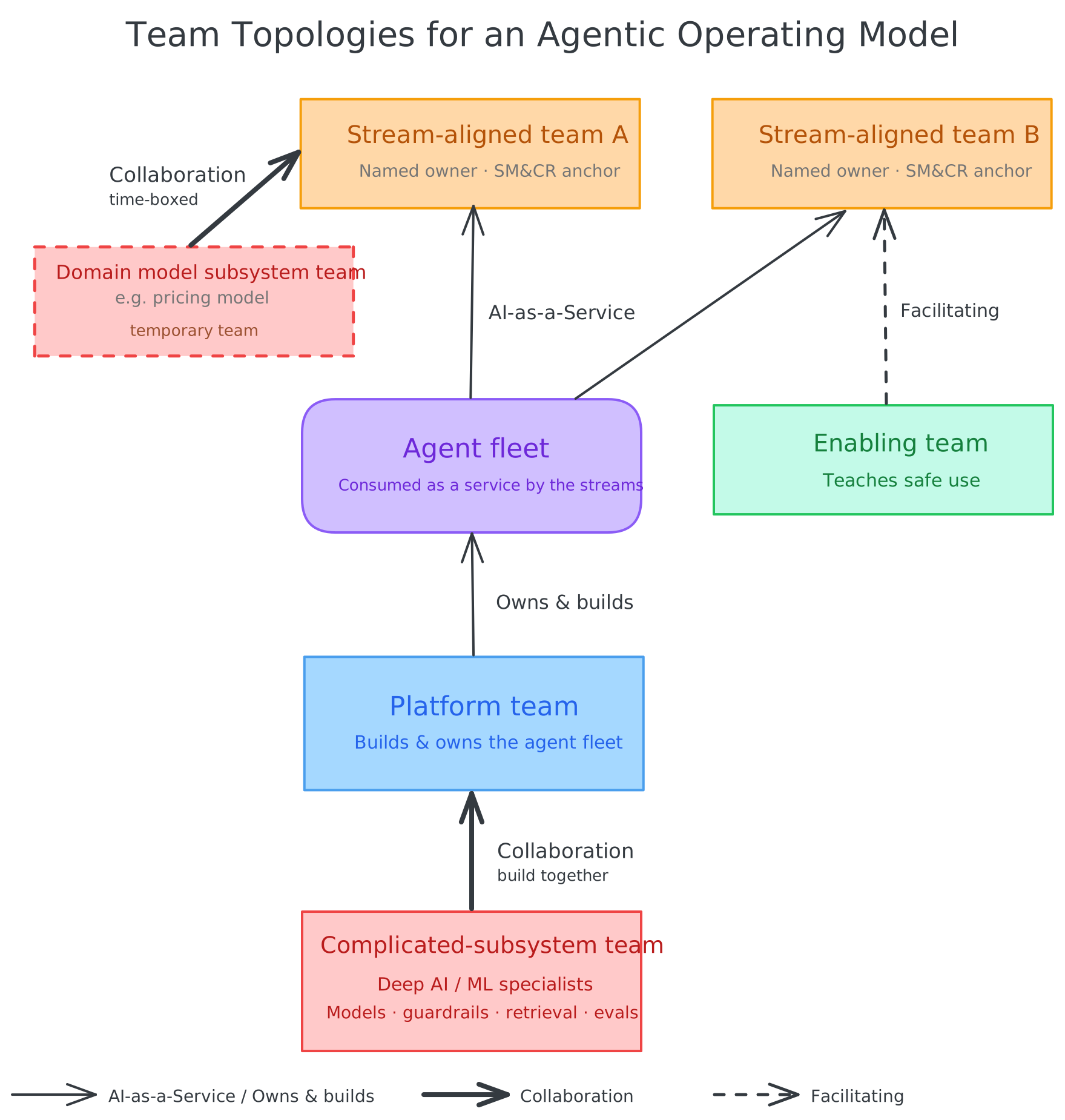
Each team type takes a clear role. The two red boxes are the same type, a subsystem team, one permanent and one temporary.
- Stream-aligned teams. Use the shared agent fleet built by other teams to deliver their part of the business, each with a single named owner accountable under SM&CR.
- Domain-model subsystem team. A specialist team created purely to build one domain model, like an insurer's pricing or reserving, then dissolved once it's done.
- Enabling team. Works alongside the stream-aligned teams to teach safe use, then steps back.
- Platform team. Owns and runs the agent fleet, built together with the complicated-subsystem team in a time-boxed collaboration, then offered to the business as a lean, standardised service.
- Complicated-subsystem team. Deep AI/ML specialists who build the shared models, guardrails, retrieval and evaluations.
However you arrange the teams, one person is always accountable: the stream's Senior Manager. Work can move between people and agents, but the decisions, sign‑offs and escalations stay with them.
Hire for Judgement, Not Stack Familiarity
Agents make routine execution cheaper, so value shifts from doing the task to judging the output. Picture the workforce as three layers. The middle narrows as agents absorb the tool specialists, and value gathers at the two ends: breadth judgement usually in the stream-aligned teams, and depth judgement mostly in the specialist subsystem teams.
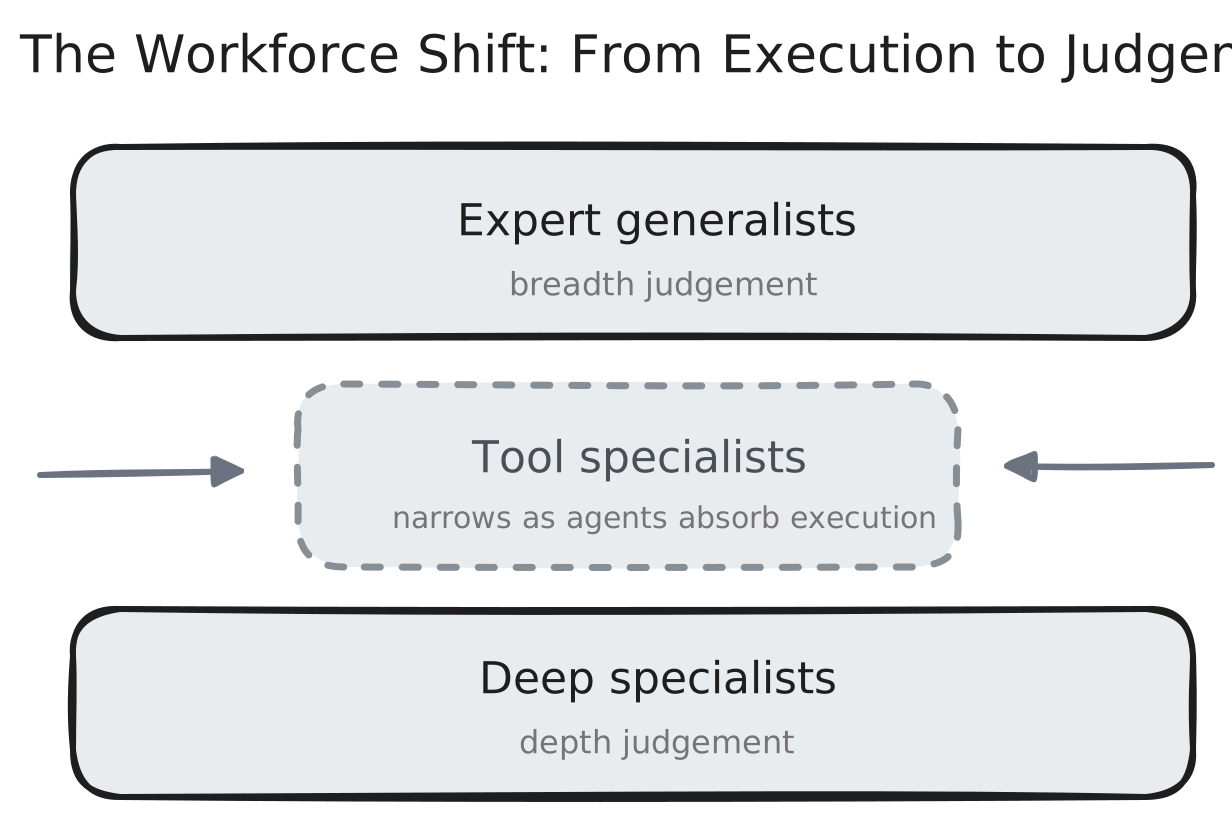
Breadth judgement (expert generalists)
The expert generalist, a term from Martin Fowler, moves into an unfamiliar domain quickly, not because they know every tool but because they lean on fundamentals that outlast any single technology. In data, for example, that means grasping how information is structured, found and traced, and those principles hold whether it sits in a decades-old database or the systems behind today's AI, even as the tools underneath keep changing.
Their limit used to be the hands-on part. They could understand a new area quickly, but were slow to actually do the work. That is exactly the limit agents remove, which is why that type of person gains most from the agentic capabilities.
What's key is that they also hold specialist knowledge in more than one area, and that's what lets them ask the right question, judge the answer, and catch when it's wrong.
Depth judgement (deep specialists)
Some decisions are too costly to get wrong and too hard to verify: pricing, security, model validation. The problem with AI is that even when it's wrong, it hands you a confident-looking answer, one a generalist can't safely sign off. That's where deep specialists step in.
There are a lot of articles debating whether AI will actually replace specialists or instead make them more valuable. My take is the latter. Depth doesn't vanish because of AI but instead starts to shift from producing answers to verifying them.
Whichever of the two you're hiring for, widen the conversation beyond which tools or stacks someone knows, and ask them to talk through real experience:
- How did they work through a genuinely hard problem?
- When did they last step into an unfamiliar domain, and how did they get up to speed?
- How do they collaborate across disciplines, inside and outside their own team?
Fix the Future Talent Pipeline
The numbers already point to a junior‑hiring problem in financial services. The workforce is weighted towards experienced staff, too few juniors are coming in, and a large share of that experience will retire or move on over the next decade. Agentic AI adds pressure as many leaders expect it to reduce demand for entry‑level roles rather than grow it.
The issue is that the routine work agents absorb is exactly what juniors used to learn on, the work that turned them into seniors. Take that away, and seniority stops accruing on its own.
So what can you do to start manufacturing that growth again?
-
Keep hiring juniors, even if agents now handle the routine tasks. The pipeline won’t refill itself, and stopping now leaves you with no seniors in years to come.
-
Shorten time to competency on purpose. Use rotations, supervised ownership of real incidents, and early exposure to the messy edges.
-
Put agents in their hands early. Agents give juniors access to more complex work sooner, but that only helps if they follow the logic behind the output. If they don’t, they gain speed but lose growth.
-
Make verification the first skill they learn. Teach them to check and challenge what the agent produces, and reward that critical thinking.
-
Review their reasoning, not just the result, so judgement still builds even when the agent did the typing.
Sources
- Boston Consulting Group (BCG Henderson Institute), AI Will Reshape More Jobs Than It Replaces (3 April 2026).
- Financial Services Skills Commission (supported by PwC), Building Your Future-Ready Workforce: An Overview of the Skills-Based Organisation Framework (November 2024).
- Deloitte, State of AI in the Enterprise 2026 (January 2026).
- Team Topologies, Key Concepts.
- Financial Services Skills Commission, A Workforce Transformed: Technology, skills and the future of work in financial services (report to HM Treasury, May 2026).
- Unmesh Joshi, Gitanjali Venkatraman & Martin Fowler, Expert Generalists (martinfowler.com, July 2025).